For years, fathers across the UK have voiced frustration with their parental leave rights, describing themselves as being “penalised for having children” and feeling as though they are “abandoning” their partners during one of the most important periods of family life. Statutory paternity leave in the UK compares poorly to European peers. The result is a system that has not kept pace with modern family life, where dual-income households are now the norm, yet two in five fathers say they cannot afford to take the leave available to them.
Eligible dads are entitled to just up to two weeks of leave following the birth or adoption of a child, paid at either £194.32 per week or 90% of their average weekly earnings, whichever is lower, before tax. For many families, this level of support falls far short of providing genuine financial security, raising questions about whether paternity leave is treated as a meaningful right or simply a minimum statutory obligation.
Better support for fathers benefits families, promotes greater equality and delivers wider economic gains. Research from the Joseph Rowntree Foundation found that extending paternity leave to six weeks at 90% of a father’s average earnings could add an estimated £2.68 billion to the UK economy.
Comparison with the UK’s peers
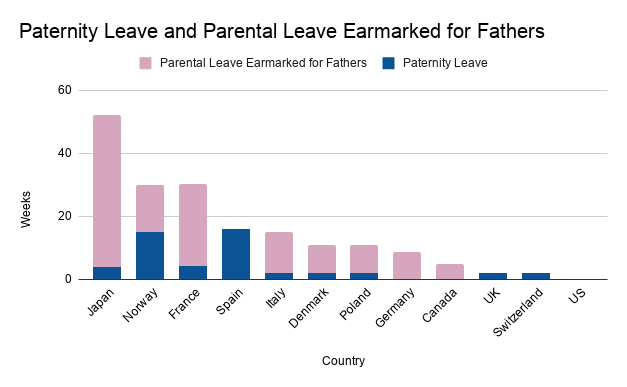
The Equality at Work: Paternity and Shared Parental Leave report notes that while British fathers can take up to two weeks of leave, dads in other countries receive significantly greater support:
- France: Four weeks of paternity leave. The first three days are mandatory and paid at 100% by the employer. The government provides a leave allowance for the remaining leave.
- Spain: 16 weeks of paternity leave at 100% salary. The first 6 weeks are mandatory.
- Denmark: Fathers are also entitled to 24 weeks of post-birth parental leave, paid through a parental allowance scheme. Two weeks need to be taken within the first 10 weeks after birth.
- Sweden: Each parent is entitled to 240 days of parental leave. Of these, 195 days are income-based, while 45 days are paid at a flat rate of 180 SEK per day.
- Poland: Two weeks of paternity leave at 100% pay, plus 41 weeks of parental leave shared between parents, with nine weeks reserved for each parent on a non-transferable “use it or lose it” basis.
Introduced by the coalition government in 2015, the Shared Parental Leave (SPL) scheme was designed to give families greater flexibility by allowing eligible parents to share leave and pay during their child’s first year. Under the scheme, mothers can choose to end their maternity leave early and transfer the remaining entitlement to be shared with their partner, enabling eligible parents to share up to 50 weeks of leave and 37 weeks of statutory pay during the first year after a child is born or adopted. Statutory payments are provided through the government’s parental leave framework.
In practice, uptake is low. Research from King’s College London found that only 1% of mums and 4% of dads make use of the scheme. Even more tellingly, 95% of those who do use SPL are among the higher half of earners. This suggests that low statutory pay continues to be a major barrier, limiting access to those who can already afford it and leaving many working families without meaningful support.
Changes from the Employments Rights Act
The Employment Rights Act, introduced a series of measures designed to strengthen paternity leave rights. The Act, which took effect, in April 2026, provides eligible fathers with more flexibility and protection.
- Paternity leave became a ‘day one right’, allowing a new parent to give notice of leave from the first day of employment. Previously employees would have had to work for the same employer for one year to be eligible for paternity leave.
- The restriction on taking paternity leave after shared parental leave has been removed.
- Eligible fathers and partners are able to take up to 52 weeks of unpaid bereaved partner’s paternity leave if the mother or primary adopter dies.
The Act, which endured a lengthy struggle through the House of Lords principally due to opposition to day one rights, is still viewed by some parliamentarians as a low baseline. In April, Labour MP Stella Creasy described the UK’s parental leave regime as “shameful”. In spite of recent reforms, UK statutory provisions remain well behind other industrialised economies (see chart).
The consequences of limited paternity leave extend well beyond fathers themselves. Mothers continue to carry the majority of childcare responsibilities during the early months of parenthood, a period that can be particularly challenging both physically and emotionally. Around one in seven mothers experiences post-partum depression, making practical and emotional support from a partner especially important during this time.
The long-term impact is significant. When mothers take most of the parental leave, they are more likely to face lower lifetime earnings, slower career progression and reduced pension savings. In turn, this widens the gender pay gap and reinforces workplace inequality.
As the UK looks towards a more inclusive and effective paternity leave framework, there is much to learn from countries that have already embraced reform. Research from Iceland found that introducing three months of paid paternity leave was associated with a considerable reduction in divorce rates. Such examples demonstrate that stronger paternity rights are not simply a benefit for dads, they can improve family wellbeing, strengthen relationships and encourage greater equality at home and in the workplace.