A policy forum for healthier, more productive workplaces
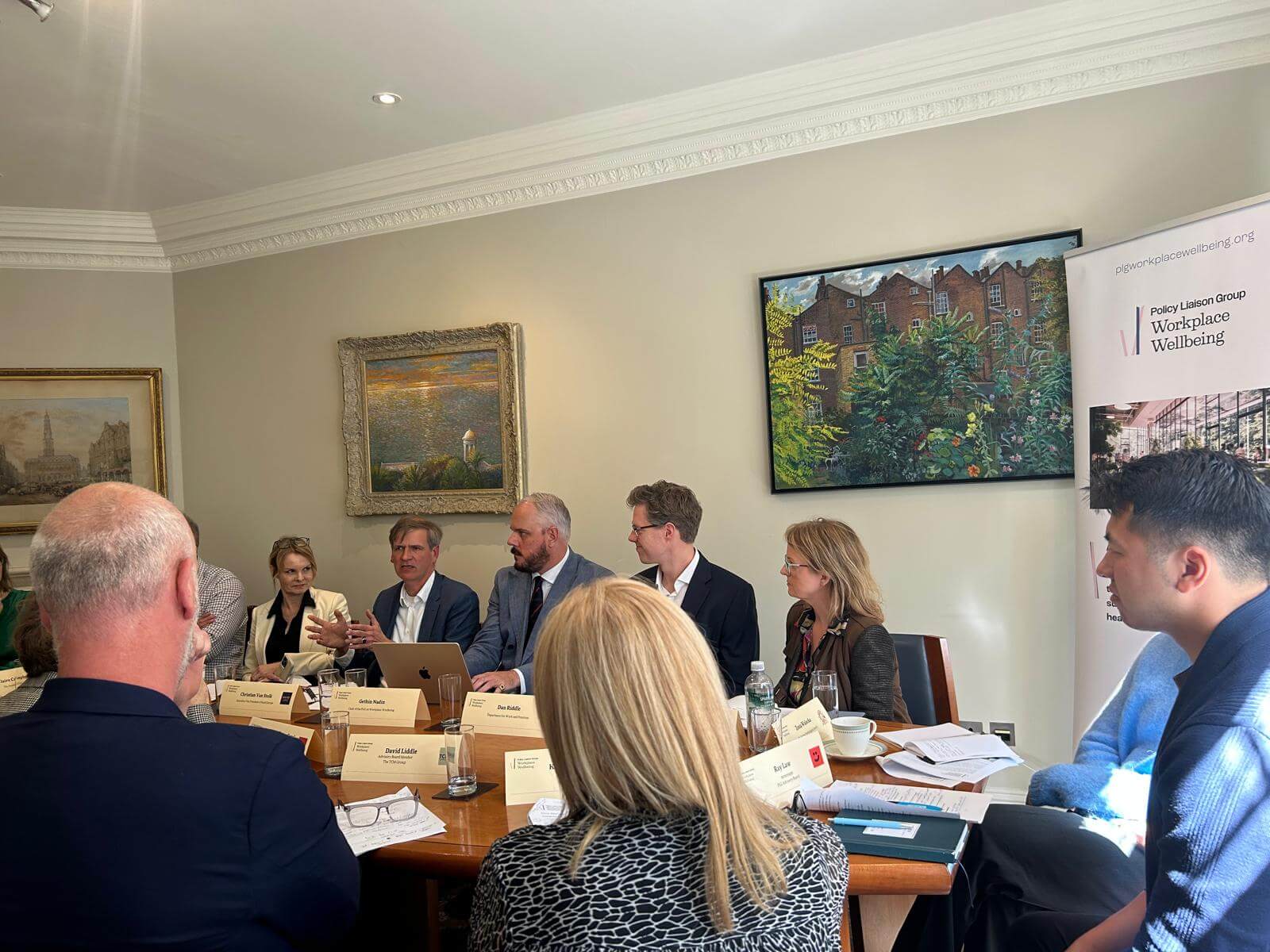
The Policy Liaison Group on Workplace Wellbeing brings together parliamentarians, business leaders and civil society to shape policy that nurtures healthier, fairer working environments, supporting physical health, mental wellbeing and financial resilience across the UK workforce. By improving how people experience work, we help drive productivity, inclusion and sustainable growth.
Latest updates
- Key takeaways
Financial wellbeing with the City of London Corporation
The Group joined the City of London Corporation at the Guildhall to explore workplace financial wellbeing. Experts highlighted the urgent need for employers to support staff through tailored savings, earned wage access, and guidance, particularly for frontline and variable-income workers.
- Key takeaways
AI, health and the future of work
This roundtable examined how AI is reshaping work, with implications for productivity, wellbeing and job quality. Chaired by Sonia Kumar MP with contributions from Simon Greenman, discussions emphasised AI as a tool for augmentation rather than substitution, particularly in health and frontline services. Participants stressed that trust, transparency, workforce engagement and human accountability are preconditions for success.
- Key takeaways
Employer-led consensus on ‘The Keep Britain Working Review’
The UK’s workforce health crisis, with long-term sickness now keeping almost 3 million people out of work, costs the economy up to £85 billion a year. Led by Professor Sir Cary Cooper, participants agreed that employee wellbeing can no longer be treated as a peripheral initiative but must be embedded into organisational systems, cultures, and expectations, and be treated as a fundamental part of business strategy.
- Key takeaways
Employment Rights Bill
As the Employment Rights Bill nears Royal Assent, this parliamentary roundtable examined what its reforms would mean for employers, workers, and policymakers across the UK. Representing the most comprehensive overhaul of employment law in a generation, these reforms promise to strengthen workplace protections, introducing day-one rights against unfair dismissal, banning exploitative zero-hours contracts, and establishing a new Fair Work Agency to enhance enforcement.
- Key takeaways
Bullying in the workplace
Building on a timely and deeply relevant issue, participants examined the systemic roots of workplace bullying, from toxic leadership and power imbalances to the breakdown of formal redress mechanisms. They emphasised how traditional grievance processes can often compound harm, underscoring the need for more human-centred, restorative approaches. This session forms part of the PLG on Workplace Wellbeing’s wider effort to develop a framework grounded in lived experience, with care, dignity, and psychological safety at its core.
- Key takeaways
Flexible working
Participants discussed how flexible working has become the norm for millions, now ranking above pay as the top priority in job searches. Yet policy and workplace practice remain slow to adapt. The Employment Rights Bill would require employers to justify refusals of flexible arrangements, such as compressed hours or a four-day week. Opening the session, Peter Dowd MP said his amendment aimed to spark debate. Participants agreed the main barriers are cultural, not evidential, and lie in management practices.
- Key takeaways
Women’s wellbeing and health in the workplace
The discussion laid bare the human and economic cost of continuing to treat women’s health as a private issue rather than a structural and cultural one. With women leaving the workforce, missing out on progression, or suffering in silence, action is needed to embed inclusive, gender-sensitive policies, equip line managers with the tools to support wellbeing, and make women’s health a shared responsibility across every level of leadership.